Archive for the 'Features' Category

Zotero and Google Tools Screencast

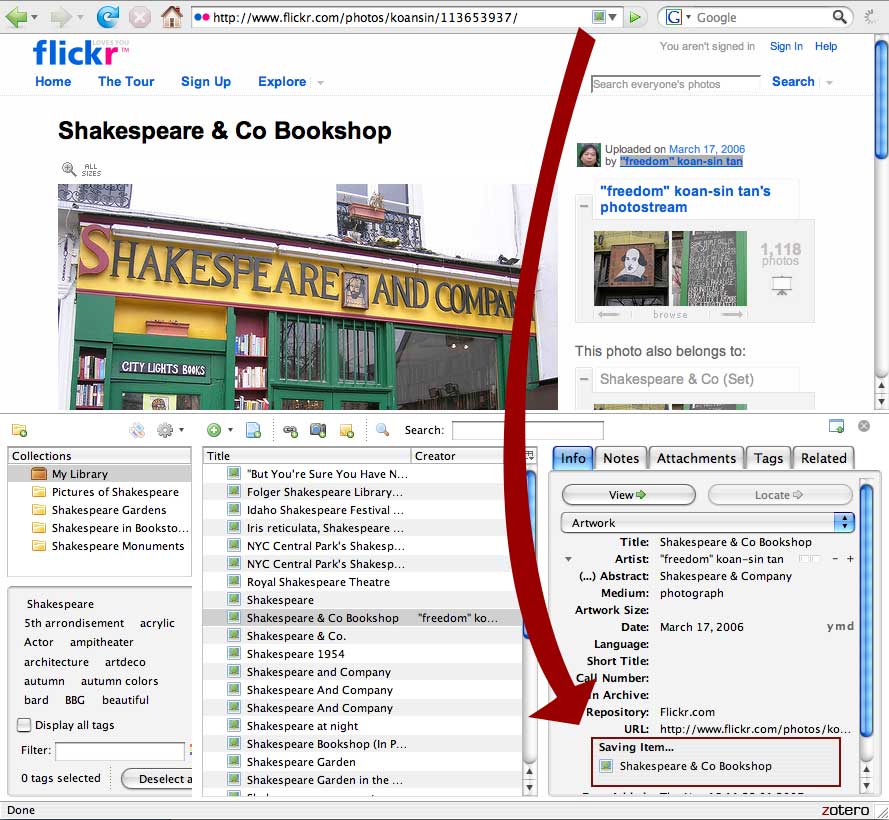
Capture items

We are launching a new series of screencasts demonstrating how Zotero enhances other online tools and services. The first screencast demonstrates how Zotero can act as a citation system for Google’s suite of tools, connecting their research repositories with their web applications. Take a look and see how easy it is to automatically capture bibliographic information from sites like Google Books and Google Scholar and simply drag and drop formated references into Google Docs.

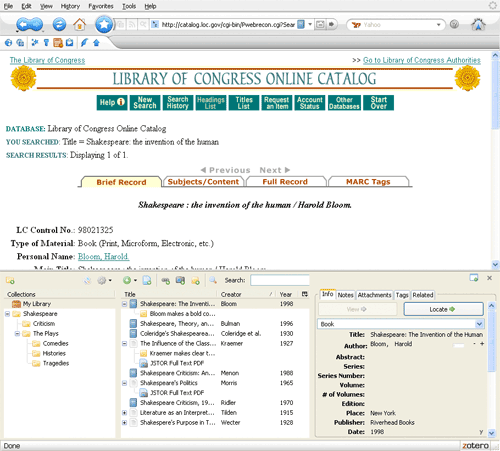
Drag and drop refferences into text fields

Bibliographies and Syllabi Just Got Smarter

Did you know that something special happens when you export bibliographies from Zotero into HTML? Zotero automatically embeds COinS metadata in these bibliographies. This means that any HTML bibliography exported by Zotero is also Zotero-readable. In other words, if you post this HTML on the web any Zotero user will be able to surf by and capture the references into their own Zotero library.

Exporting with embedded metadata opens the door for what we like to call “smart syllabi,” where students can capture the bibliographic information for all the readings in a course with the click of a button. You can also publish “smart publications” on the web, where a reader needs just a single click to capture one or all of your your citations. With a “smart CV” anyone interested in your work can instantly capture your entire publication history.

To export an HTML bibliography all you need to do is:

1) Right-click (or control-click) on any collection, item, or items and select “Create Bibliography.”
2) Choose the bibliographic format you want to use and choose “Save as HTML.”
3) Name your bibliography and choose where to save it.
4) Now if you open that bibliography in Firefox you will notice that you can see the folder icon. You can post this bibliography to the web, and any one with Zotero will be able to capture it.

Smart bibliographies, syllabi, CVs, and publications are just a few more examples of how Zotero continues to offer easy-to-use, intuitive, unique features for those doing research—and those they wish to communicate with.

Annotate and Highlight Your Archived Pages

One of Zotero 1.0 Beta 4’s most exciting new features is its in-page annotation functionality. With this feature you can now work with web resources in the same way you would with printed materials by highlighting and adding sticky notes to your archived pages.

When you open a web-snapshot you will now see the annotation tool bar:

Click the highlight icon to turn your cursor into a highlighter, then click and drag to highlight text. If you decide to undo your highlighting, you can click the un-highlight icon and select text to remove the highlighting.

To add sticky notes, click the add annotation icon. Now wherever you click on the page you will add a sticky note. You can hide the annotation by clicking on the collapse annotation speech bubble in the top right corner of the note. To resize the note, click the bottom right corner and drag. If you would like to delete a sticky, click the delete annotation box in the upper left corner of the note. To toggle all your annotations in and out of view, click the show and hide annotation buttons on the annotation toolbar.

The annotation functions now available in Zotero 1.0 Beta 4 make an already solid platform for digital research even more powerful. By allowing you to work with archived web snapshots in the same ways you would with conventional print resources, these annotation features help to streamline the digital research process.

To see a screencast of the new annotation features in action, click the thumbnail below:

Making the Switch to Zotero

Many people coming to Zotero already have extensive collections stored in other reference management software. The following information describes how to make the move from EndNote to Zotero, but the same basic steps apply to many other reference management systems.

How to Import From EndNote
In EndNote, select “Output Styles” from the Edit menu. From the list of output styles select RefMan (RIS). (If you do not see RIS as an option, you’ll need to download the style from the EndNote site.) It could also be that the style is not enabled.  You may have to go open the Output Styles Manager from the Edit menu, enable RIS, then close the manager before it’s an option.) Once RefMan (RIS) is set as the format, select “Export” from the File menu. In the Export window that pops up, choose “Text Only”, select the RIS output style immediately below “Text Only” in the dialog, and hit “Save.” After exporting from EndNote, click on the gear icon () above the left column in your Zotero pane and select Import from the pull-down menu. In the filesystem window that pops up, locate the RIS file you exported from EndNote and select “Open.” Your references should be imported into Zotero.

If you have any issues related to importing and exporting references, try searching the forums. You may well find quick tips to help you solve your problem. If your search doesn’t turn up the answer you were looking for, post your question to the forums. This is the quickest way to get information from the Zotero team.

Feature Spotlight: Tagging

This week we are profiling some of the new features accompanying the Zotero 1.0 Beta 3 release. Today we would like to highlight the expanded tagging functions now available in Zotero.

Tagging is an easy way to categorize items by attaching descriptive words to them. You can tag your information with whatever relevant keyword or term you would like associated with that given item. These tags allow you to sift through your information in a personal way, by the categories that deem relevant.

Located in the bottom-left-hand corner of your screen, the tag selector adds an additional layer of information management to complement the collection and search systems. The selector updates its inventory from tags you place on individual items in your Library. By clicking on any of the tags you can filter the items within your Library, collections and saved searches by as many or as few tags as you like.

You can toggle the tag selector in and out of view by clicking the tag selector box icon (). The tag selector defaults to showing all the tags on items in the current folder. When you click on a given tag, the center pane updates to display only the items with that tag. You can select multiple tags to further focus the results in the center pane or click on a tag again to deselect it. To quickly find a tag in the list, type part of its name in the Filter box; selected tags not matching what you type remain selected, allowing you to quickly find and select multiple items. It is also possible to click the “Deselect all” button to return the center pane to displaying all the items in the selected folder.

From this box you can also control the tags globally. By right-clicking on a tag (or Control-clicking on the Mac) you can choose to rename a tag across all items or delete it from all of the records it is attached to. You can also assign tags to multiple items at once by dragging items from the items pane onto tags in the tag selector. This is where the “Display all tags” checkbox comes in handy: while the tag selector normally only shows you tags on items in the current view, clicking “Display all tags” causes tags not assigned to currently visible items to appear in gray. You can then drag items onto one of the gray tags to assign it to those items.

As an example, while working on your project on the history of bottled water (see above image), you decide to tag five items “Bottled Water.” It is as easy as selecting the items and dragging them onto the Bottled Water tag in the tag selector box.

Note that some items that you save will come with tags already attached. If Zotero detects classification information or other metadata as part of a catalog record, it will, in some cases, extract that information as a tag. For example, OPAC (Online Public Access Catalog) record subject headings become Zotero tags. You can manage these automatic tags in the same way that you manage the tags you add manually.